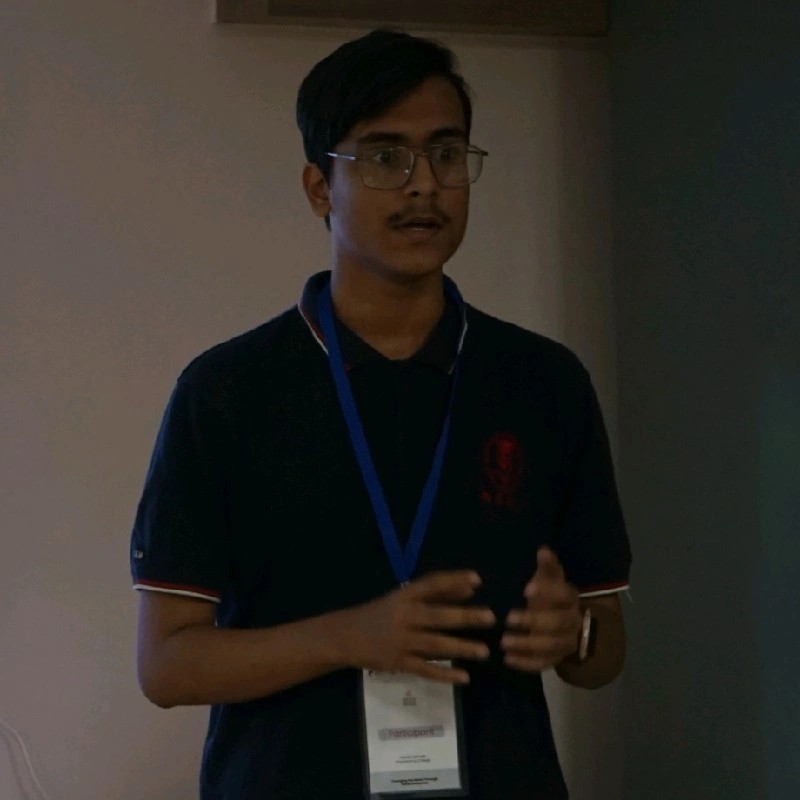
I am Sukalyan Roy

a Backend Engineer

Backend Engineer specializing in high-performance data systems and distributed architecture. Designed and deployed EEG ingestion/analysis backends for 20GB+ medical datasets and optimized processing by 90%. SIH 2023 National Finalist.

Contact: sukalyanroyofficial@gmail.com

Sukalyan Roy — Backend Engineer

My Skills

code
Languages

Python, Java, SQL, JavaScript, C/C++

precision_manufacturing
Backend & ML

FastAPI, Flask, REST, OAuth
NumPy, pandas, PyTorch, TensorFlow

storage
Databases

PostgreSQL, Redis, SQLite

build
Tools

Git, Linux, Bash, Docker, pytest, CI


My Experience

  • Backend Developer
    [June 2025 - Present]

    Architected microservices platform (5 services, 50+ APIs, Redis, PostgreSQL) processing 20GB+ EEG datasets simultaneously on the cloud with 90% faster processing, 75% reduced memory and <100ms real-time streaming latency at Avinya Neurotech. Built cloud data pipeline on Azure Blob Storage with PDF/EDF+ export, frequency band analysis and async job processing; also worked on a standalone desktop EEG viewer with PyTorch-based artifact/spike detection.

  • College Clubs Lead
    [April 2025 - Present]

    Lead of Cybernix and GNX (Tech Team) – managed 16+ Core members; conducted several workshops; mentored juniors.

  • Tech Development Intern
    [Nov 2024 - Jan 2025]

    Built a RAG-based internal knowledge assistant over 300+ pages of documentation at Aecho AI, reducing information retrieval from minutes to seconds. Stack: Python, Streamlit, LM Studio.


My Education

  • B.Tech (CSE) [2022-2026]

    Netaji Subhash Engineering College, New Garia, Kolkata under MAKAUT
    GPA: 7.90/10.0 (as of 7th Sem) | SVMCM and Reliance Scholar
    Coursework: DSA, OS, DBMS, CN, ML, Cybersecurity, Pattern Recognition
    Final Year Project: MediPredict - AI powered Full Stack Insurance Premium assistant

  • ISC & ICSE [2020-2022]

    National Gems Higher Secondary School, Behala, Kolkata under CISCE
    ISC (12th): 90% | ICSE (10th): 92%


Shipped work

Production backend 20GB+ EEG datasets

Cloud EEG Ingestion & Analysis Platform

  • Problem: Medical EEG workflows needed reliable ingestion, analysis, exports, and real-time review for large datasets without exhausting memory.
  • Architecture: 5-service microservices platform with 50+ APIs, PostgreSQL for structured state, Redis for coordination/caching, Azure Blob Storage for large files, async jobs for analysis/export, and a streaming path for live review.
  • Tradeoffs: Moved heavy analysis out of request paths, favored object storage over local disk, and balanced real-time latency against batch frequency-band analysis and EDF+/PDF export jobs.
  • Outcome: Processed 20GB+ datasets, improved processing speed by 90%, reduced memory usage by 75%, and kept real-time streaming latency under 100ms.
FastAPIPostgreSQLRedisAzure BlobPyTorch

AI backend 300+ pages indexed

Internal RAG Knowledge Assistant

  • Problem: Internal documentation was spread across hundreds of pages, making answers slow to find and easy to miss during day-to-day work.
  • Architecture: Python ingestion pipeline over 300+ pages of documentation, retrieval-first answer flow, Streamlit interface, and local LM Studio inference for a lightweight internal assistant.
  • Tradeoffs: Chose a local/private model workflow over a hosted API, prioritized fast retrieval and simple UX over a complex agent stack, and kept the first version easy to iterate with stakeholders.
  • Outcome: Reduced internal information retrieval from minutes to seconds while keeping the system simple enough to maintain and demo quickly.
PythonRAGStreamlitLM StudioLLMs
Systems project NAND → assembler

Nand2Tetris Hardware Stack & Two-Pass Assembler

  • Problem: Build a small computer from first principles and translate Hack assembly into executable 16-bit machine code.
  • Architecture: HDL logic gates, ALU, memory hierarchy, program counter, memory-mapped I/O, plus a Python assembler split into parser, code-generation, symbol-table, and orchestration modules.
  • Tradeoffs: Used explicit translation tables and a two-pass algorithm for correctness and readability; chose Python over tutorial C++ to avoid copying and make the implementation easier to inspect.
  • Outcome: Built through the hardware portion, reached 16K memory, implemented an ALU capable of 18 operations via 6 control bits, and generated .hack binary output from .asm programs.
PythonAssemblerHDLAssemblyComputer Architecture

Certifications

Kept as supporting signals; the main proof is now in the case studies above.

Harvard CS50 Track

2023 - 2026

CS50x, CS50 Cybersecurity, and CS50 AI — C, SQL, Python, networking, security, transformers, and project-based problem solving.

Smart India Hackathon 2023

National Finalist

CodeRedX finalist team; built the AI chatbot model for a mental health chatbot using TensorFlow with Flutter/Firebase integration.


Contact Me

Feel free to reach out to me on any of the following platforms: